Official Golf Card Game Rules: The Complete Reference (2026)
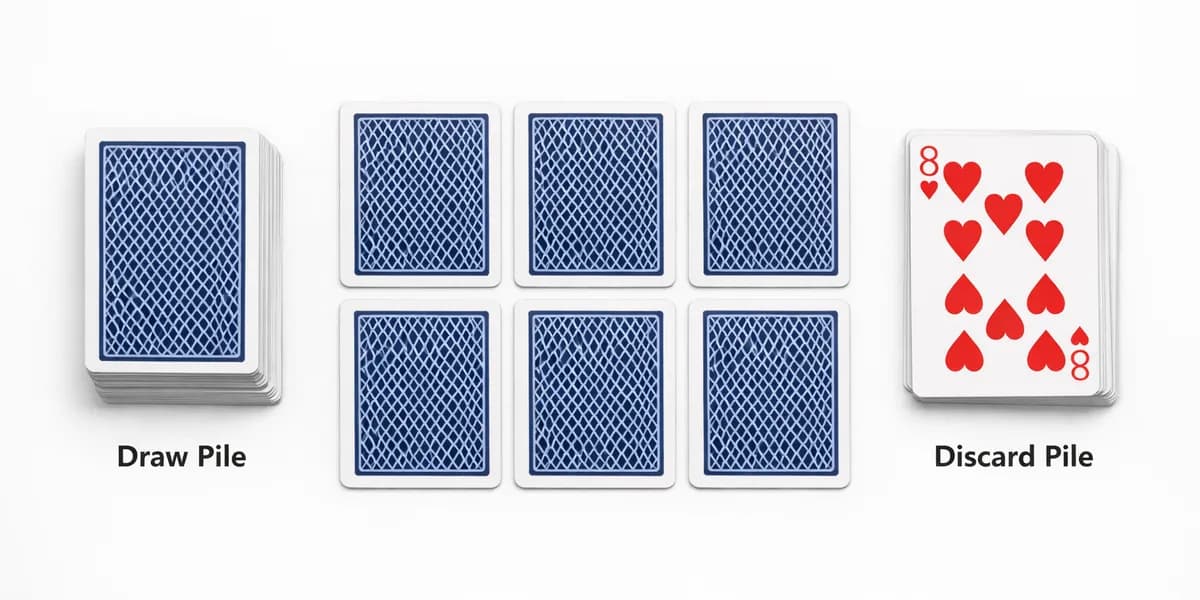
Table of Contents
1. Equipment & Setup
1.1 Required Equipment
- Standard 52-card deck: One complete deck of standard playing cards. Jokers are not used in standard play, though some variants include them.
- Scoring materials: Paper and writing implement, or digital scoring device, to track scores across multiple holes.
- Playing surface: A flat surface large enough to accommodate each player's 2x3 grid of cards plus the draw and discard piles.
1.2 Player Count
Golf card game is designed for 2-6 players. The game works with any number in this range, though optimal play is typically with 3-4 players. With 2 players, games are faster and more strategic. With 5-6 players, games take longer and the discard pile becomes more active.
1.3 Initial Setup Procedure
- Shuffle the deck thoroughly. In tournament play, the dealer shuffles and the player to the dealer's right cuts the deck.
- Deal 6 cards face-down to each player. Cards must be dealt one at a time, in rotation, until all players have 6 cards.
- Each player arranges their 6 cards in a 2x3 grid (two rows, three columns) in front of them. The arrangement is at the player's discretion, but cards must remain in the grid formation throughout the hole.
- Place the remaining deck face-down in the center as the draw pile.
- Turn the top card of the draw pile face-up and place it next to the draw pile to start the discard pile.
- Each player flips exactly two of their six cards face-up. These are the only cards visible at the start of the hole. The remaining four cards stay face-down.
- Determine starting player. Standard method: player with highest face-up card value goes first. In case of tie, proceed clockwise from dealer. Alternative: dealer goes first, or use any agreed-upon method.
1.4 Grid Layout Specification
The 2x3 grid must be arranged as follows:
Cards are organized into three vertical columns. Column 1 consists of the leftmost cards from rows 1 and 2. Column 2 consists of the middle cards. Column 3 consists of the rightmost cards. This column structure is critical for the pair rule (see Section 2.3).
2. Objective & Scoring
2.1 Primary Objective
The objective of Golf card game is to achieve the lowest cumulative score over the course of multiple holes. A standard game consists of 9 holes, though variants may use different numbers. After all holes are completed, the player with the lowest total score is the winner.
Unlike most card games where higher scores or completing objectives wins, Golf follows the principle of the sport of golf: lower scores are superior. A score of 15 beats a score of 30, just as in actual golf.
2.2 Card Point Values
Each card has a specific point value used for scoring:
- Aces: 1 point
- 2s: -2 points (negative value)
- 3s through 10s: Face value (3 = 3 points, 7 = 7 points, 10 = 10 points)
- Jacks: 10 points
- Queens: 10 points
- Kings: 0 points
These values are absolute and do not change based on suit. A 5 of hearts and a 5 of spades both score 5 points. A King of diamonds and a King of clubs both score 0 points.
2.3 The Vertical Pair Rule
This is the most important special rule in Golf card game. If two cards of the same rank occupy the same vertical column (one in row 1, one in row 2 of the same column), that entire column scores 0 points, regardless of the individual card values.
Example 1: Column 1 contains a Queen (10 points) in row 1 and a Queen (10 points) in row 2. Normally this would score 20 points, but because they form a vertical pair, the column scores 0 points.
Example 2: Column 2 contains a 7 in row 1 and a 7 in row 2. Normally 14 points, but the pair reduces it to 0 points.
Special Case - Pair of 2s: If a column contains two 2s (each worth -2 points), the column scores -4 points total, not 0. The pair rule doesn't override the negative value of 2s; it applies the pair benefit to the already-negative cards.
Important: Horizontal pairs (same row, different columns) do NOT receive this benefit. Only vertical pairs (same column) count. A 7 in row 1, column 1 and a 7 in row 1, column 2 do not form a scoring pair.
2.4 Calculating Hole Score
At the end of each hole, calculate each player's score as follows:
- All face-down cards are revealed and turned face-up.
- Calculate the score for each of the three columns separately.
- For each column, check if it contains a vertical pair. If yes, that column scores 0 (or -4 if it's a pair of 2s). If no, add the point values of the two cards in that column.
- Sum the scores of all three columns. This is the player's score for that hole.
- Add this hole score to the player's cumulative total.
Example Calculation:
2.5 Game Completion and Winner Determination
After all agreed-upon holes are completed (standard is 9 holes), each player's cumulative score is calculated. The player with the lowest total score is declared the winner.
In case of a tie, see Section 4.2 for tiebreaker procedures.
3. Turn Structure
3.1 Turn Order
Play proceeds clockwise from the starting player. Each player takes one complete turn before play passes to the next player. Turn order does not change during a hole unless a player is eliminated (not applicable in standard Golf).
3.2 Turn Components
A complete turn consists of three phases, which must be completed in order:
- Draw Phase: The player must draw one card from either:
- The draw pile (face-down deck), OR
- The discard pile (top face-up card only)
The player may look at the drawn card before proceeding. Once a card is drawn, the player cannot change their mind and draw from the other source.
- Action Phase: The player must take one of the following actions:
- If drawn from deck: The player may either:
- Swap the drawn card with any one of their six cards (face-up or face-down), OR
- Discard the drawn card immediately. If this option is chosen, the player MUST flip one of their face-down cards face-up.
- If drawn from discard pile: The player MUST swap the drawn card with one of their six cards. They cannot discard a card taken from the discard pile.
- If drawn from deck: The player may either:
- Discard Phase: If a swap occurred, the card that was removed from the player's grid is placed face-up on top of the discard pile. If the player discarded a card drawn from the deck, that card is placed on the discard pile. The discard pile should always have only one face-up card visible (the top card).
3.3 Swapping Procedure
When swapping a card:
- The player announces which card in their grid they are swapping (by position or description).
- The player removes the card from their grid and places it aside temporarily.
- The player places the new card in the exact same position.
- If the removed card was face-down, it is now revealed. If it was face-up, it remains visible.
- The removed card is then placed on the discard pile.
Important: Cards must remain in their grid positions. A card cannot be moved to a different position in the grid during a swap. The swap is a one-for-one replacement in the same location.
3.4 Discarding from Deck - The Penalty Rule
If a player draws from the deck and chooses to discard the card immediately (rather than swapping), they must flip one of their face-down cards. This is not a point penalty, but an information penalty—the player must reveal a card they could have kept hidden.
The player chooses which face-down card to flip. They may not flip a card that is already face-up. Once flipped, the card remains face-up for the remainder of the hole.
3.5 Ending a Hole
A hole ends when one player has flipped all six of their cards face-up. This can happen:
- Through normal play (swapping and flipping cards)
- Through discarding from deck (which requires flipping a face-down card)
- Through a combination of both
When a player flips their sixth and final card face-up, they signal that the hole is ending. Play then proceeds as follows:
- The player who flipped all cards announces "hole over" or similar signal.
- Each remaining player (in turn order) takes ONE final turn.
- After all final turns are complete, all remaining face-down cards are flipped face-up.
- Scores are calculated for the hole.
- Scores are recorded and added to cumulative totals.
- A new hole begins with fresh cards.
4. Special Rules & Edge Cases
4.1 Deck Exhaustion
If the draw pile is exhausted before a hole ends, proceed as follows:
- Remove the top card of the discard pile and set it aside. This card remains as the new discard pile starter.
- Shuffle all remaining cards from the discard pile (everything except the top card that was set aside).
- Place the shuffled cards face-down to form a new draw pile.
- Place the set-aside card face-up next to the new draw pile as the new discard pile.
- Play continues normally.
This procedure ensures the game can continue even if a hole takes many turns. The top discard card is preserved to maintain game state.
4.2 Ties in Scoring
If two or more players have identical cumulative scores at the end of the game, use one of the following tiebreaker methods (agreed upon before the game begins):
- Sudden Death: Play additional holes until one player achieves a lower score than all others in a single hole. That player wins.
- Lowest Single Hole: Among tied players, the player with the lowest single-hole score wins. If still tied, the player with the second-lowest single-hole score wins, and so on.
- Most Holes Won: Count how many individual holes each tied player won (had the lowest score). The player who won the most holes is the winner.
- Shared Victory: Players may agree to share the victory. This is common in casual play.
4.3 Disputed Memory Claims
Golf card game relies on memory, and disputes about card positions can arise. Official rules:
- No verification allowed: Players may not look at face-down cards to verify memory claims. Once a card is face-down, it remains hidden until legally revealed.
- Honor system: The game operates on an honor system. Players are expected to play fairly and not claim knowledge they don't have.
- Dispute resolution: If a player disputes another's memory claim, the claim cannot be verified until cards are revealed. If the claim proves false, it is considered a mistake, not cheating, unless there is evidence of intentional deception.
- Tournament play: In official tournaments, memory disputes are resolved by tournament officials. Players may request a ruling if they believe an opponent is making false memory claims.
4.4 Accidental Card Reveals
If a face-down card is accidentally revealed (dropped, flipped by mistake, etc.):
- The card is immediately turned face-down again if possible.
- All players who saw the card must forget the information (honor system).
- If the card cannot be hidden again, it remains face-up and play continues.
- No penalty is assessed unless the reveal was intentional (cheating).
4.5 Player Error Corrections
If a player makes an illegal move:
- If discovered before the next player's turn begins, the move may be corrected.
- If discovered after the next player's turn begins, the move stands and play continues.
- Repeated illegal moves may result in penalty points or disqualification in tournament play.
5. Variants
5.1 Classic Golf (Standard)
- Cards per player: 6 cards (2x3 grid)
- Number of holes: 9 holes
- Play time: 15-20 minutes
- Rules: Standard rules as described in this document
5.2 Quick Golf
- Cards per player: 4 cards (2x2 grid)
- Number of holes: 6 holes
- Play time: 10-15 minutes
- Rules: Same as Classic, but with 2 columns instead of 3. Vertical pairs still apply (one card in row 1, one in row 2 of the same column).
5.3 Extended Golf
- Cards per player: 6 cards (2x3 grid)
- Number of holes: 18 holes
- Play time: 30-40 minutes
- Rules: Same as Classic, but with double the holes. This variant tests consistency over a longer game.
5.4 Jokers Variant
- Deck: Standard 52-card deck plus 2 jokers (54 cards total)
- Joker value: -2 points (same as 2s)
- 2s value: 2 points (changed from -2)
- All other rules: Same as Classic
- Note: This variant increases the number of negative-value cards available, making lower scores more achievable.
6. Tournament Rules
6.1 Official Tournament Format
Official Golf card game tournaments use the following format:
- Variant: Classic Golf (6 cards, 9 holes)
- Player count per table: 4 players
- Number of rounds: Determined by tournament size (typically 3-5 rounds)
- Scoring system: Cumulative score across all rounds. Lowest total score wins.
- Tiebreakers: See Section 4.2
6.2 Tournament Conduct
- Players must maintain silence during play, except for necessary game communication.
- No outside assistance is permitted. Players may not receive advice or information from spectators.
- Cell phones and electronic devices must be silenced and put away during play.
- Players must keep their cards visible to opponents at all times (face-up cards) and hidden (face-down cards) as appropriate.
- Time limits may be imposed per hole or per game at tournament director's discretion.
6.3 Penalties and Disqualification
- Illegal move: First offense: warning. Second offense: 5-point penalty. Third offense: disqualification from the round.
- Cheating: Immediate disqualification from the tournament.
- Unsportsmanlike conduct: Warning, then disqualification if behavior continues.
- Time violations: 2-point penalty per minute over time limit.
7. Scoring Reference Table
| Card | Point Value | Notes |
|---|---|---|
| Ace | 1 | Low value, good to keep |
| 2 | -2 | Negative value, excellent card |
| 3 | 3 | Face value |
| 4 | 4 | Face value |
| 5 | 5 | Face value |
| 6 | 6 | Face value |
| 7 | 7 | Face value |
| 8 | 8 | Face value |
| 9 | 9 | Face value |
| 10 | 10 | Face value, high card |
| Jack | 10 | High value, prioritize replacing |
| Queen | 10 | High value, prioritize replacing |
| King | 0 | Perfect card, always keep |
Vertical Pair Scoring
- Any matching pair in same column: Column scores 0 points
- Pair of 2s in same column: Column scores -4 points (not 0)
- Pair of Kings in same column: Column scores 0 points
- Horizontal pairs (same row): No special scoring, add values normally
8. Common Rule Disputes
8.1 "Can I look at my face-down cards?"
Official ruling: No. Face-down cards may not be looked at until they are legally revealed through play or at the end of a hole. Looking at face-down cards is considered cheating and results in immediate disqualification in tournament play.
8.2 "Do horizontal pairs count?"
Official ruling: No. Only vertical pairs (cards in the same column) receive the 0-point benefit. Horizontal pairs (cards in the same row, different columns) score normally by adding their individual values.
8.3 "What if I forget to flip a card when discarding?"
Official ruling: If discovered before the next player's turn, the error must be corrected immediately. If discovered after the next player's turn begins, the error stands and play continues. In tournament play, this may result in a warning or penalty.
8.4 "Can I move cards to different positions?"
Official ruling: No. Cards must remain in their original grid positions throughout the hole. When swapping, the new card goes in the exact same position as the removed card. Cards cannot be rearranged within the grid.
8.5 "What if two players flip all cards simultaneously?"
Official ruling: The player whose turn it is when the final card is flipped is considered to have ended the hole. If both players flip their final cards on the same turn, the player whose turn it was (the one who acted first) is considered to have ended the hole.
9. House Rules (Optional Variations)
Many groups develop their own house rules over time. These are not official but are commonly used in casual play. All house rules must be agreed upon by all players before the game begins.
9.1 Horizontal Pairs Allowed
Some groups allow horizontal pairs (same row) to score 0 points, in addition to vertical pairs. This makes the game easier and provides more pairing opportunities.
9.2 Look Once Rule
Players are allowed to look at their face-down cards once per hole. This reduces the memory component but makes the game more accessible to new players.
9.3 No Penalty Discard
Some groups remove the requirement to flip a card when discarding from the deck. This makes the game less punitive but reduces strategic depth.
9.4 Knock Variant
Players can "knock" to signal they believe they have the lowest score, even if they haven't flipped all cards. When someone knocks, everyone gets one final turn, then the hole ends. This adds a bluffing element to the game.
Important: House rules are for casual play only. Official tournaments use only the standard rules as described in this document.
10. Frequently Asked Questions
Q: What happens if the deck runs out during a hole?
A: Shuffle the discard pile (except the top card) to form a new draw pile. The top card of the discard pile remains as the new discard starter. See Section 4.1 for complete procedure.
Q: What happens if there is a tie score?
A: Use one of the tiebreaker methods described in Section 4.2. Most common is playing additional holes until a winner is determined, or using lowest single-hole score as tiebreaker.
Q: Can you look at your face-down cards?
A: No. Face-down cards may not be looked at until they are legally revealed. Looking at face-down cards is cheating. See Section 8.1.
Q: Do horizontal pairs score zero?
A: No. Only vertical pairs (cards in the same column) score zero. Horizontal pairs score normally. Some house rules allow horizontal pairs, but this is not official. See Section 2.3 and 8.2.
Q: What is the penalty for drawing from the deck and discarding?
A: You must flip one of your face-down cards. This is not a point penalty, but an information penalty—you must reveal a card. See Section 3.4.
Q: Can I swap a card I just drew with another card I just drew?
A: No. You can only swap the card you just drew with one of the six cards currently in your grid. You cannot swap two cards from your grid with each other in a single turn.
Q: What if I accidentally reveal a face-down card?
A: If accidental, turn it face-down again if possible. All players must forget the information (honor system). If it cannot be hidden, it remains face-up. See Section 4.4.
Q: How many cards can I flip at the start?
A: Exactly two cards. No more, no less. These are the only cards visible at the start of the hole. See Section 1.3.
Q: Can I change my mind after drawing a card?
A: No. Once you draw a card, you must complete your turn with that card. You cannot return it and draw from the other source.
Q: What if the discard pile only has one card and I want to draw from it?
A: You can still draw the top card of the discard pile. If this leaves the discard pile empty, the next player who draws from the deck and discards will start a new discard pile with that card.
This document represents the official, comprehensive rules for Golf card game as of 2026. These rules have been compiled from traditional play, regional variations, and consensus among experienced players. When in doubt, refer to this document as the authoritative source.
For questions not covered in this document, consult with experienced players or tournament officials. House rules may be used in casual play, but official tournaments and competitions use only the rules specified herein.
Ready to Play?
Now that you know the complete rules, put them into practice!