Complete Beginner's Guide to Golf Card Game (2026)
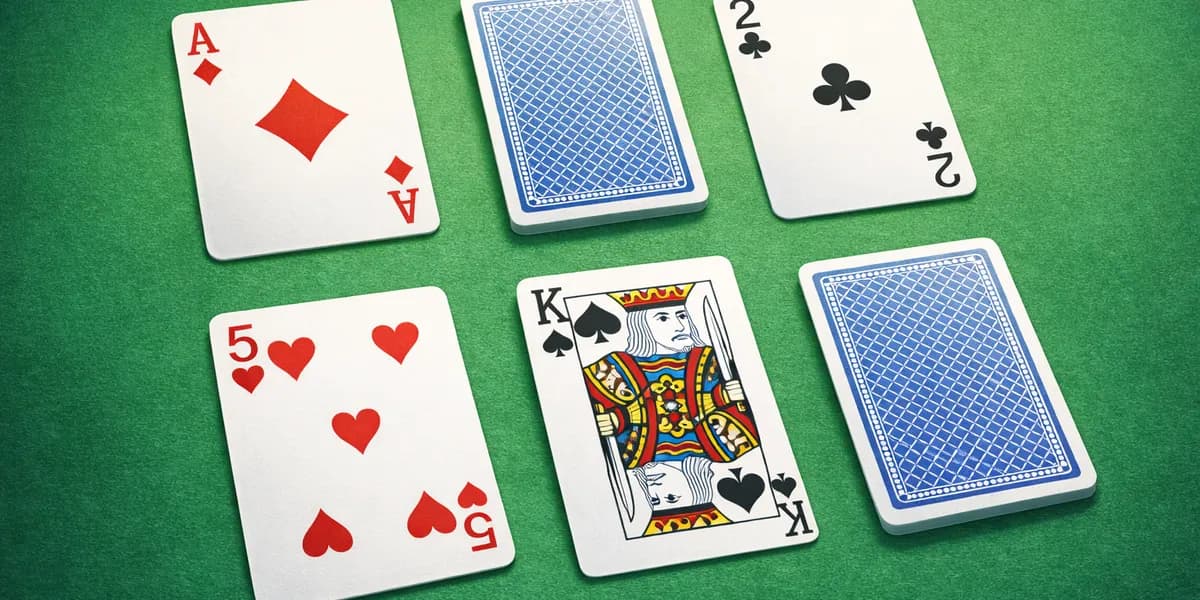
So you just learned about Golf card game (also known as Polish Poker or Cabo), and now you're wondering: "Where do I even start?" Don't worry—you're in the right place! This guide is designed to take you from "I've never played this game" to "I can confidently play and enjoy Golf" in about 20 minutes. We'll walk through everything step-by-step, explain the rules in simple terms, and help you avoid the common mistakes that trip up new players.
Golf card game is one of those games that looks simple on the surface but has surprising depth once you start playing. The good news? It's genuinely easy to learn. Unlike some card games that take hours to understand, you can grasp the basics of Golf in just 5 minutes. The strategic depth reveals itself as you play, which makes it perfect for beginners who want to feel competent quickly while still having room to grow.
Think of this guide like a friendly coach sitting next to you, explaining each step as you go. We'll use analogies, visual descriptions, and real examples to make everything crystal clear. By the end, you'll not only know how to play—you'll understand why certain strategies work and feel confident enough to jump into your first game. Let's get started!
What Do You Need to Play Golf Card Game?
The beautiful thing about Golf card game is how simple the requirements are. You don't need special equipment, expensive game boards, or complicated setups. Here's everything you need to get started:
- 1.Standard 52-card deck:Any regular playing card deck works perfectly. No jokers needed, no special cards—just a standard deck you probably already have at home.
- 2.2-4 players:Golf works great with 2, 3, or 4 players. If you're playing online (like on our site), you can play solo against AI opponents, which is perfect for learning at your own pace.
- 3.Paper and pencil for scoring:You'll need to track scores across 9 holes. A simple piece of paper works great, or you can use a notes app on your phone. If you're playing online, the game tracks scores automatically for you!
- 4.15-20 minutes:A full game of Golf takes about 15-20 minutes. It's the perfect length for a quick break, a coffee break, or fitting in a game between other activities. The Quick variant (4 cards, 6 holes) takes even less time—about 10 minutes—which is great for learning.
That's it! No complicated setup, no special equipment. If you're playing online, you don't even need the deck or paper—everything is handled for you. This simplicity is part of what makes Golf so accessible. You can literally start playing in the next 5 minutes.
How Do You Play Golf Card Game?
Let's break down the rules in the simplest way possible. Think of Golf like actual golf: you want the lowest score. In real golf, par is the target, and going under par (birdie, eagle) is great. In Golf card game, every point counts against you, so lower is always better. A score of 10 beats a score of 30, just like in real golf.
The Goal: Lowest Score Wins
You play 9 rounds, called holes (one round of play). After each hole, you add up your points. After all 9 holes, whoever has the lowest total score wins. It's that simple!
Setup: Your 2×3 Grid
Imagine your cards laid out like a 2×3 grid (two rows, three columns). It looks like this:
You start with 6 cards face-down. Flip any two cards to begin—these are the only cards you can see at first. The rest stay hidden until you flip them or the hole ends.
Turn Structure: Draw → Swap or Discard
On your turn, you do three things:
- Draw: Take a card from either the draw pile (face-down cards to draw from) or the discard pile (face-up cards that have been discarded)
- Decide: If you drew from the deck, you can swap (exchange the drawn card with one in your grid) it with any of your 6 cards OR discard it immediately (but if you discard, you must flip one face-down card—a hidden card you haven't seen). If you drew from the discard pile, you MUST swap it—you can't just discard it.
- Discard: If you swapped, put the old card face-up on the discard pile. If you drew from discard and swapped, put the card you removed on the discard pile.
Ending a Hole: Someone Knocks
A hole ends when one player has flipped all 6 of their cards face-up. When this happens:
- The player who flipped all cards signals the end (or it happens automatically online)
- Everyone else gets ONE final turn
- All remaining face-down cards are flipped
- Everyone calculates their score for that hole
- Scores are added to the running total
- Start a new hole with fresh cards!
Card Values (The Scoring System)
Here's how points work—memorize this, it's crucial:
- Aces: 1 point
- 2s (the most valuable cards): -2 points (yes, negative! These are amazing)
- 3-10: Face value (3 = 3 points, 7 = 7 points, etc.)
- Jacks & Queens (the worst cards): 10 points each
- Kings: 0 points (perfect for keeping score low)
Special Rule: If you have a vertical pair (two matching cards in the same column—vertical stack of 2 cards), that entire column scores 0 points! This is huge—a pair of Queens (normally 20 points) becomes 0 points if they're stacked vertically.
Your First Game: Step-by-Step
Let's walk through your first few turns with a real example. This will help you see how everything comes together. Don't worry if it seems like a lot at first—after a few turns, it becomes automatic.
Initial Setup
You're dealt 6 cards face-down. You arrange them in your 2x3 grid. Let's say your grid looks like this (you can't see the face-down cards yet):
You flip two cards to start. Let's say you flip the top-left and bottom-middle cards. They reveal: Queen (10 points) and King (0 points). Great! You already have a King, which is perfect.
Now you can see two cards. The Queen is high (10 points), so you'll want to replace it. The King is perfect (0 points), so you'll want to keep it.
Turn 1: You Draw a King
You draw from the deck: It's a King (0 points). Excellent card!
Decision point: You have a Queen (10 points) face-up. You should swap the King with the Queen immediately. This saves you 10 points!
Action: You swap the King with your Queen. Now your grid looks like:
Result: You discard the Queen. Your score improved from having a 10-point card to having a 0-point card. Great first move!
Turn 2: You Draw a 7
You draw from the deck: It's a 7 (7 points). Not great, but not terrible either.
Decision point: You have two Kings (0 points) face-up. You don't want to replace those! You have four face-down cards. You could:
- Swap the 7 with a face-down card (risky—you don't know what it is)
- Discard the 7 and flip a face-down card (safe—you get information)
Smart choice: Discard the 7 and flip a face-down card. You reveal a 3 (3 points). Good! Now you know you have a 3, which is a low card worth keeping.
Result: You've gained information without hurting your score. The 3 is a keeper, and you've learned what one of your hidden cards was.
Turn 3: Opponent Discards a 2
The discard pile shows: A 2 (-2 points). This is an amazing card! Remember, 2s are worth -2 points, which actually helps your score.
Decision point: You can take this 2 from the discard pile, but you MUST swap it with one of your cards. You have:
- Two Kings (0 points)—don't replace these!
- A 3 (3 points)—could replace, but 3 is already pretty good
- Two face-down cards—unknown values
Smart choice: Take the 2 and swap it with one of your face-down cards. You reveal it was a 9 (9 points). Perfect! You've replaced a 9 with a -2, which is an 11-point improvement!
Result: Your score is looking great. You have two Kings (0 points), a 3 (3 points), and a 2 (-2 points). That's only 1 point so far! You're doing excellent.
See how it works? Each turn, you're making decisions to improve your position. Sometimes you take risks (swapping with face-down cards), sometimes you play it safe (discarding and flipping). The key is thinking about what each move does for your score. After a few more turns like this, you'll have the hang of it!
What Are Common Beginner Mistakes to Avoid?
Everyone makes mistakes when learning a new game—that's totally normal! But knowing these common pitfalls will help you avoid them and feel more confident. Don't worry if you've already made some of these; recognizing them is the first step to improving.
1. Flipping Corner Cards First (Wrong!)
Many beginners flip the corner cards (top-left and bottom-right) first because they're easy to remember. But this is actually suboptimal! The middle column gives you more strategic information because it's flanked by other columns, making it easier to plan pairs.
Better approach: Flip cards in the middle column first, or flip cards that are adjacent to each other. This gives you more opportunities to create vertical pairs, which are worth 0 points.
2. Knocking Too Early
When you flip all your cards, you end the hole. Beginners often rush to flip everything, thinking they're ahead. But this gives everyone else one final turn to improve! If you're not confident you have the lowest score, keep at least one card face-down to get more turns.
Better approach: Only flip your last card when you're confident you're ahead, or when you need to end the hole quickly to lock in a good score. Otherwise, keep cards face-down to get more opportunities to improve.
3. Forgetting to Track Opponent's Discards
The discard pile is public information, and it tells you a lot! Beginners often focus only on their own cards and ignore what opponents are discarding. But watching the discard pile helps you understand what cards are still available and what opponents don't want.
Better approach: Pay attention to what gets discarded. If you see multiple high cards (Queens, Jacks) being discarded, those cards are still in circulation. If you see a King or 2 in the discard pile, grab it if you can use it!
4. Not Targeting High Cards
Beginners sometimes swap low cards (like a 3 for a 2) when they still have high cards (Queens, Jacks, 10s) face-down. This is inefficient! Replacing a Queen (10 points) with a 3 (3 points) saves you 7 points. Replacing a 3 with a 2 only saves 1 point.
Better approach: Always prioritize replacing your highest-value cards first. If you have a Queen face-down and you draw a King, swap it with the Queen, not with a low card. The math is simple: bigger cards = bigger point savings.
5. Playing Too Cautiously
Some beginners are so afraid of revealing bad cards that they never take risks. They only swap with face-up cards they can see, avoiding any face-down swaps. While this is safe, it limits your opportunities to improve.
Better approach: Calculated risks are part of the game. If you have a face-down card in a position where you know you have a high card (maybe you saw it earlier), swap it! If you draw a great card (like a King or 2) and you have face-down cards, sometimes it's worth the risk to swap and see what you get.
Remember: making mistakes is how you learn! Don't beat yourself up if you make these errors in your first few games. Even experienced players make these mistakes sometimes. The key is recognizing them and learning from each game.
How to Practice and Improve
Like any skill, getting better at Golf takes practice. But the good news is that Golf is a fun game to practice! Each game teaches you something new, and you can see your improvement over time. Here's a roadmap to go from beginner to confident player.
Start with the Quick Variant
The Quick variant uses 4 cards instead of 6, and 6 holes instead of 9. This means:
- Less to track (easier to learn)
- Faster games (10-15 minutes instead of 20)
- More practice opportunities (you can play more games in the same time)
- Same core strategies (everything you learn applies to Classic)
Think of Quick as your training wheels. Once you're comfortable with Quick, moving to Classic is just scaling up what you already know.
Play Against Beginner AI First
When you're learning, play against Beginner AI. This gives you:
- Time to think without pressure
- Opportunity to make mistakes and learn from them
- Chance to win some games (which builds confidence!)
- Understanding of basic strategy before facing tougher opponents
Don't rush to Intermediate or Expert AI. Master the basics first. Once you're consistently beating Beginner AI, then move up. There's no shame in taking your time—every expert was once a beginner.
Focus on One Strategy at a Time
There are many strategies in Golf: memory, pair formation, discard pile reading, timing, etc. Don't try to master everything at once!
Week 1: Focus on remembering your card positions. Make it a game—can you recall where each card is without looking?
Week 2: Focus on targeting high cards. Make it a rule: always replace Queens, Jacks, and 10s before anything else.
Week 3: Focus on pair formation. Actively try to create vertical pairs, even if it means keeping a high card temporarily.
By focusing on one skill at a time, you'll build a solid foundation. Then you can combine all the skills naturally.
Track Your Scores to See Improvement
One of the most motivating things about Golf is seeing your scores improve over time. Keep track of:
- Your average score per game
- Your best game score
- How often you beat the AI
- Your scores by difficulty level
When you see your average score drop from 45 to 35 to 25, you'll know you're improving! This tangible progress is incredibly satisfying and keeps you motivated to keep playing and learning.
Remember: improvement in Golf (like any game) isn't linear. Some days you'll play great, some days you'll make mistakes. That's normal! The key is consistent practice. Even 10-15 minutes a day will show improvement over time.
Next Steps: Intermediate Concepts
Once you've mastered the basics and can consistently play competent games, you're ready to explore intermediate strategies. These concepts will help you go from "I can play" to "I can win consistently."
Advanced Strategies to Explore
- •Memory techniques: Develop systems for remembering card positions and values. Some players use spatial memory, others use number systems. Find what works for you.
- •Discard pile reading: Learn to interpret what opponents are discarding and what that tells you about remaining cards in the deck.
- •Timing and risk assessment: Know when to take calculated risks versus playing it safe. This comes with experience and understanding probability.
- •Column management: Think of your grid as three columns, not six individual cards. Plan pairs and optimize column scores strategically.
- •Difficulty-specific strategies: Learn how to adjust your play style for Beginner vs Intermediate vs Expert AI opponents.
These concepts are covered in depth in our Strategy Guide and 10 Expert Tips. Once you feel comfortable with the basics, check those out to take your game to the next level.
You might also want to explore different game variants. While we currently offer Classic, Quick, and Extended variants, understanding the different ways Golf can be played will deepen your appreciation for the game and give you more options for different situations.
Frequently Asked Questions
Is Golf card game hard to learn?
No. The basic rules can be learned in 5 minutes: deal 6 cards in a grid, flip 2 to start, draw and swap to lower your score, lowest total after 9 holes wins. The strategy depth comes from practice, not complex rules.
What's the difference between Golf card game and the sport of golf?
They share only one thing: lowest score wins. Golf card game is a tabletop card game using a standard 52-card deck. The name comes from the scoring concept, not the sport itself. Some believe it originated from a Polish game called "Gofas."
How many people can play Golf card game?
Golf works best with 2-4 players. With 2 players, games are faster and more strategic. With 4 players, there's more competition for good cards in the discard pile. Online, you can play solo against AI opponents at different difficulty levels.
What should I focus on as a complete beginner?
Start with three things: (1) memorize your card positions, (2) always replace your highest cards first, and (3) watch for pair opportunities. Don't worry about advanced strategies until you're comfortable with the basics.
Why do 2s have a negative value?
2s are worth -2 points, making them the most valuable cards in the game. This creates interesting strategic choices—a pair of 2s in a column scores -4 points (not 0), which can significantly lower your total score.
Congratulations! You've made it through the complete beginner's guide. You now understand the rules, know how to avoid common mistakes, and have a roadmap for improvement. That's a lot to be proud of!
Remember: everyone starts as a beginner. Don't worry if you lose your first few games—that's completely normal. Even experienced players have bad games sometimes. The important thing is that you're learning, practicing, and having fun. Golf is a game that rewards patience and practice, and you'll see improvement faster than you might expect.
The best way to learn is by playing. Reading guides is helpful, but nothing beats actual experience. Each game teaches you something new, whether it's a new strategy, a mistake to avoid, or just getting more comfortable with the flow of play.
Ready to Play Your First Game?
Start with Beginner AI and take your time. There's no rush, no pressure—just you, the cards, and a fun strategic challenge. You've got this!